


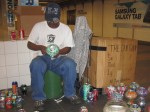
His dream in life was to be an artist. And though, Bernard Lewis, 54, is not the artiste he envisioned becoming, he’s found his fame and fortune peddling his creations in the subway stations and streets of Manhattan.
For the past 28 years, Lewis has been digging deep into trash searching for empty soda and beer cans. Using a single-edge razor, he cuts and slices them – vertically, horizontally, diagonally. With a cigarette lighter and rag, he shapes them with a few pinches and squeezes.
His objet d’art can be a pencil caddy or anything the imagination fancies, explains Lewis. Recently, he had a subway rider place an order for 50 Coca-Cola cans that she said was going to be candle centerpieces at her wedding reception.
In the wintertime, a well-groomed Lewis, dressed in jeans and a T-shirt, sets up shop in the subway station at Grand Central Terminal. He scatters cans of different brands and sizes on the pavement in front of him and shouts, “‘Only in New York!'” to passersby as he sits on a large, green plastic bucket, baseball cap pulled over metal frame eyeglasses, fashioning cans.
In warm weather, Lewis goes en plein air to 59th Street and Columbus Circle where he tries to catch the Lincoln Center crowd, he says. But his preferred location is Times Square where “the tourists just eat ’em up,” he says of his cans.
On a good day, Lewis says he sells 60 cans. “I probably could sell mo’ if I stayed out longer,” he offers with a toothless chuckle.
Lewis works five days a week, seldom sweating more than six hours a day. Occasionally, he’ll work into the night and on weekends, he says.
“I make mo’ money doing this than any job I ever had,” says Lewis.
The best part of his job is working when he wants, and doing what he wants, he says. “I’m my own boss and nobody tells me what to do.”
Unlike many artists who are struggling to survive in these hard economic times, Lewis says, the recession hasn’t had an impact on his growing business.
“Every year I’m selling mo’ and mo’ cans, and it just keep going up,” he says. Mondays are his busiest day, summers his busiest season.
So, what’s Lewis’ best-seller? “Coca-Cola, hands down,” he says. Ten years ago, Budweiser was popular, “but it ain’t no mo’, now it’s my number two.”
When his inventory is low, Lewis looks for collectors eager to sell their cans for a nickel a piece, the same amount offered at redemption centers.
Lewis doesn’t worry about competition. “Ain’t nobody doing what I’m doing,” he says, “’cause ain’t nobody who can do what I do.”
The scars on Lewis’ hands tell of the cost of mastering his art. “At first I used to get cut a lot,” he admits, “but no mo’.”
Getting arrested is Lewis’ biggest fear. Recently, he was charged with peddling, his cans confiscated and fined $90.
Lewis says he knows who the “bad” cops are that will tell him to leave or arrest him; he also knows the “good” ones who sometimes stop to watch him work and even drop a coin in the tip bucket.
Lewis sells 12-ounce cans for $3.00 each and can cut and shape one in less than 10 minutes; a 16-ounce can takes 15 minutes and sells for $5.00, while a 24-ounce one takes about a half hour to do and nets him $10.00.
As Lewis lures crowds to his treasure borne out of another man’s trash, he demonstrates – with surgical precision – how to transform a soda and beer can into an artistic creation that only he – the can man – can do.
Fascinating.
“The worst of days of those who enjoy what they do
are better than the best days of those who don’t.”
–Jim Rohn
 A Cup of Life
What a great great story. Thanks for sharing…